

Undergraduate Research Culture: Student and Professor Collaboration
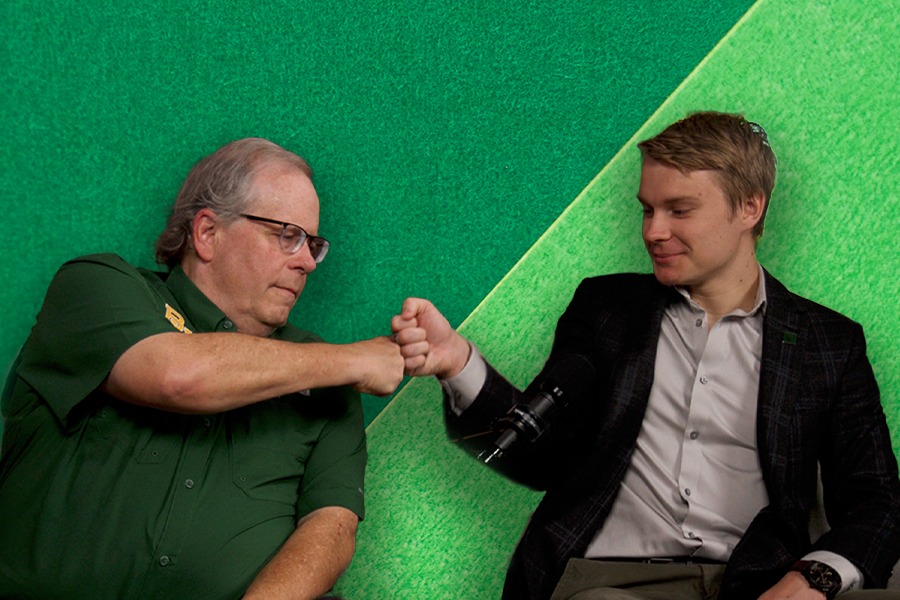
How does the undergraduate research experience impact students at Baylor? Go inside a research lab with a student and his faculty mentor, a nationally renowned cancer researcher. Dr. Kevin Pinney, professor of chemistry and biochemistry, and Devin Guedry, a rising junior from Frisco, Texas, together explore the collaborative culture that defines undergraduate research at Baylor.
From developing potential cancer therapies to navigating the challenges and rewards of scientific discovery, Pinney and Guedry share how faculty mentorship, student curiosity, and hands-on learning create opportunities for growth both inside and outside the laboratory.
Show Notes
How does the undergraduate research experience impact students at Baylor? Go inside a research lab with a student and his faculty mentor, a nationally renowned cancer researcher. Dr. Kevin Pinney, professor of chemistry and biochemistry, and Devin Guedry, a rising junior from Frisco, Texas, together explore the collaborative culture that defines undergraduate research at Baylor.
From developing potential cancer therapies to navigating the challenges and rewards of scientific discovery, Pinney and Guedry share how faculty mentorship, student curiosity, and hands-on learning create opportunities for growth both inside and outside the laboratory.
THE CONVERSATION INCLUDES:
- how Baylor combines nationally recognized undergraduate teaching and research opportunities for students
- the collaborative culture inside the Pinney Lab, where undergraduate and graduate students work side by side
- research focused on developing potential new therapies and treatment strategies for cancer
- how students learn resilience, problem-solving, and adaptability through setbacks and unexpected challenges
- Devin Guedry’s experience conducting cancer-related research through Baylor’s B-TRUE undergraduate research program
- the role of faculty mentorship in helping students grow as researchers and future professionals
- why undergraduate researchers are valued contributors rather than observers in the scientific process
- how Baylor’s research community encourages curiosity, discovery, and tackling difficult questions
- the connection between undergraduate research, medical education, and future careers in healthcare and science
- what makes Baylor’s undergraduate research culture distinctive for students pursuing a wide range of academic interests
Transcript
Derek Smith:
Today we're talking undergraduate research on Baylor Connections. Undergraduate research, a big part of the Baylor experience for so many students. And it's easy to see why. Baylor is one of just 19 schools in the nation in the top 40 in both undergraduate research and undergraduate teaching. It's an area that continues to grow at the university.
And today we want to dive into what that looks like for students. And to do so, we're going to visit the world of chemistry. Longtime chemistry professor and researcher, Dr. Kevin Pinney is with us today on the program along with one of his students, a rising junior, Devin Guedry. He's from Frisco, Texas, and he works in Dr. Pinney's lab. And today, they're going to take us inside what that looks like and what goes on there. Dr. Pinney, Devin, thanks so much for joining us. Great to have you both here.
Kevin Pinney:
Yeah, thanks for having us on the show, Derek.
Devin Guedry:
Happy to be here.
Derek Smith:
Good to have you here. Kevin and Devin, a good rhyming duo name here with us on the program. And Devin works inside your lab as an undergraduate. We're going to look inside. You have all levels of students within your lab, Dr. Pinney, but let's start off with something simple. If you look over, let's just go with the last week or so. What's been your favorite aspect for each of you of working inside the lab thus far in the last week?
Kevin Pinney:
Yeah, no, that's a great question. I think that always what's one of the favorite things is interacting with the students. So with the graduate students, undergraduate students, if I think back over the last week, I've been working with Devin on a presentation he's going to give tomorrow to the Be True Program on a literature article that relates to his research in the lab.
And working with the graduate students, we're getting abstracts ready for the Cancer Prevention Research Institute of Texas CPRIT conference this fall and getting our. We are blessed to have a grant from CPRIT and we're pulling together our annual report for that. And then it's not just in my lab, it's all the collaborators that are a part of it. So just interacting with them I think has been the highlight so far of the last two weeks.
Derek Smith:
Great. What about you, David?
Devin Guedry:
Honestly, it might sound a little weird, but I earlier this week lost everything I'd been working on the last three weeks. And at first I was like, "Okay, this is awful. I lost everything. It's three weeks worth of stuff."
But really, I kind of got back on my feet, got a lot of support from my graduate student. And we were able to bounce back, get to exactly where we were within one week, and we have double now with what we're working with instead of what we had before.
Derek Smith:
So you figured out that you can have what seems like a catastrophic problem hit you and you can work your way through it?
Devin Guedry:
Yep. Learning from failure. That's the number one thing I've learned.
Derek Smith:
Well, if you didn't already know, you could do it, now you know you can for sure. Well, good work on that. That is pretty cool to hear that because I think for a lot of students, when they think about undergraduate research, it can be a little intimidating. It sounds very intimidating to lose three weeks worth of work, but you're able to bounce back from it.
Devin Guedry:
Yep.
Derek Smith:
That's exciting.
Kevin Pinney:
And what's especially neat about it is I think this is the first I've heard about it. And you see, this is what's great about my lab. They insulate me from these things until there's a problem, right? Then they're very good at problem solving on their own. So I mean, they know I'm always available, but that's fantastic that you got the material back that quickly.
Derek Smith:
You're always there, but you love seeing them take that ownership?
Kevin Pinney:
Right. Well, I always try to be available, but not micromanaging in a sense, because I know they're very capable. And so, they'll often solve these sorts of things on their own without me, which is great. So that dynamic of the graduate students working with the undergraduates is really fantastic.
Derek Smith:
Well, Kevin, for those of us without a chemistry background, let's orient our listeners and viewers to your lab. What is the Pinney Lab? What takes place there and what are you trying to do?
Kevin Pinney:
Yeah. In a very general sense, we're really interested in cancer therapeutics. So new treatments, potential treatments down the road for cancer that could be highly effective and highly selective. And so, there we work on new small molecules. We work on delivery strategies. And we're one piece in a large chessboard. So we work with lots of collaborators on the biology side, cancer imaging technologies, interesting delivery mechanisms that are sort of beyond the scope of our lab.
And in that sense at Baylor, you probably know, I've worked with the Maryland Trawick's group for a long time. So that's a great collaboration. Helps us really do initial synthesis, design of molecules, synthesis of molecules, and then initial assessment against cancer cell lines and mechanism of action. Then we're blessed to have lots of collaborators, quite a few at University of Texas Southwestern Medical Center who work with us for imaging, cancer biology, et cetera. So overall, really the goal is to try to improve the situation for cancer patients down the road with improved therapies that are more effective and selective.
Derek Smith:
So if we have a loved one who has cancer disease and they're taking a drug for that, you go way back down the line, there was someone like you or maybe you and your lab yourself who was testing like a natural product that thought had the ability to fight cancer and you're figuring out why and how to make that better?
Kevin Pinney:
Yeah. If you look at the history of cancer therapy over the last 50 years, the advancements are now exponentially increasing. And so, big credit to pharmaceutical companies, universities across the world that are really developing new therapies, exciting new approaches, and able to advance those fairly rapidly. So we're a tiny little cog in a wheel of all of this, but it's really fun for our lab and cool and motivational to think that we're playing potentially a little part in that.
Derek Smith:
And Baylor has done well in that. You think you and your colleagues in chemistry and biochemistry, biology, you were seeing more in the Robbins College of Health and Human Sciences. There's a lot of people playing into that fight against cancer.
Kevin Pinney:
Yeah. And I think Baylor has been very supportive of that. And yeah, over the last 20 years, we've really continued to develop expertise in cancer, looking at it from all different angles as you mentioned. So lots of colleagues working in that area.
Derek Smith:
Kevin, we know that Devin is a part of your lab, but broadly, who is in your lab? Who all plays a role in that?
Kevin Pinney:
Yeah. In a general sense, I sort of typically have 5 to 10 members of my group, and they're usually a mix of graduate students, undergraduate students, and occasionally postdocs when I have enough grant support to support postdocs. So that's the group that is working in the Baylor Sciences building as a unit. And then as I mentioned, we really benefit from lots of collaborations with others.
Derek Smith:
And so, you've got all different age groups, right? You've got the 18 to 22-year-olds, then those pursuing their masters, then their PhDs, but everyone has an important role to play, it sounds like?
Kevin Pinney:
Yeah, absolutely. In my lab, I don't sense that there's any hierarchy in that sense. Everyone's equal contributors. And if you think about the undergraduates, even someone like Devin, first off in the lab, there's great energy that he brings to what we're doing, and inquisitiveness, and asking questions that maybe we haven't thought about in that same way that he's asking them. And that's always true for the undergraduate students and graduate students as well. So it's really a harmonious team effort.
Derek Smith:
So Devin, let's find out a little bit more about what and why you are doing what you do there in the Pinney Lab. So let's just say you ran home to a family reunion and an aunt or uncle said, "So what are you doing this summer? What are you doing at Baylor?" How would you describe that?
Devin Guedry:
Well, I'd have to break it down a little for them, because it's a lot. So the Be True Program, the Baylor Transdisciplinary Research for Undergraduate Experiences. It's this program that I applied to, and they reached back out to me right before the summer started, asked me if I wanted to do the program. I said, "Yeah, sure."
So it's a 10-week program for the summer, and it is supposed to be research-based. It's about 20, 25 people are in the program right now, and they all are from different backgrounds. So some of us are in chemistry, some of us are in biology, some of us are in physics, everything. And we all come together and talk about it.
So I'm with Dr. Pinney with chemistry. And so he assigned me with the project to synthesize a molecule called combretastatin D2, and it's another anti-cancer agent. It works as... I guess, we're looking into its ability as a vascular disrupting agent to see how it can sort of choke off the blood vessels in a tumor and starve it of oxygen. So we are trying to make that right now.
So earlier when I said I lost everything, I was about halfway through making it, but we're back there now. So we're just trying to get to the end of it. And then, we're going to, right after that, see what we can do to tweak the molecule a little bit, see what works better, what doesn't work as well, and we're going to see what we can do from there.
Derek Smith:
There's probably no shortage of angles from which you can... And what's the name of the molecule again?
Devin Guedry:
Combretastatin D2.
Derek Smith:
Combretastatin D2, probably a lot of angles you could attack it from to see where it does what it does?
Devin Guedry:
Mm-hmm.
Derek Smith:
Where does this derive from? Sometimes it's a natural world. What does it derive from?
Devin Guedry:
So it is a natural product. It's from the same tree as another molecule, combretastatin A, which is pretty studied. Works a little differently, but it's from the South African Bushwillow. So all the combretastatin molecules were found in the South African Bushwillow.
Kevin Pinney:
Yeah. And this goes back, Derek, to work by Professor Pettit from Arizona State University. And he unfortunately passed away a few years ago, but what a prolific scientist. So when I was a very young faculty member, he sort of took me under his wing as a senior colleague in terms of mentorship, but he also opened me up to a world of collaborators I wouldn't have had access to. And we became very good friends.
He's a natural products chemist, and so he went around the world collecting natural products. And this comes from the bark of the combretum [inaudible 00:10:25] from a Bushwillow tree in Africa. And we've had Bob Pettit here on our campus for the W. Dial Black Family Lectures many years ago. And so there's a lot of connections there.
And so as Devin was saying, the vascular disrupting agents, this is, I think, a really interesting area. So these are molecules that shut down selectively and effectively blood flow to tumors. They do it by a mechanism that's completely different from the well-known angiogenesis inhibiting agents. In other words, to break that down for listeners a little bit more, tumors, if you want to personify them, are unfortunately clever, and they will do many things that are clever. One thing is they say, "Hey, I want to get bigger. I'm going to recruit blood flow here. I want it to come to me, not to my healthy friends nearby."
And they sort of hijack that normal angiogenesis process. And there's molecules that have been developed that fight back against that. However, the molecules we're working with go to existing vessels that are already there to tumors and disrupt them. And so, no FDA approved agents that work that way yet, but I think it's a really interesting and fascinating approach. And so, it's great that Devin's working on that with these combretastatin D series of molecules.
Derek Smith:
Devin, when you were applying to Baylor thinking about what you want to do, was something like this even on your radar?
Devin Guedry:
I think I always knew I wanted to do something with cancer. I've had family members with cancer and I know a lot of friends. It's just something that I know one of the biggest problems in the world. And I wanted to do my little impact I can while I'm in my undergrad. And so, it was something that I always had in the back of my mind.
And then sort of when I started taking Dr. Pinney's class, because he taught me organic chemistry I and II, I think that sort of took off when he mentioned within the first few days of class, about his lab. And I was curious. So I looked into it, and it sounded really cool. Now, I opened up one of his articles and it was in a whole different language. I sort of broke it down and started reading it and I was like, "This stuff's really cool."
So I think later, second semester, it was me and another undergraduate that's also in his lab now. We were wandering around the hallway and we ran into him and he's like, "Hey, do you want to come tour the lab?"
"Sure, why not?"
So we walk into his lab, we look around, it's awesome. I could tell immediately when we walked in that it was a comforting, warm lab. And also, I could look inside and see what they were doing. And I was like, "This is really cool." So it was something that I think is really important to me. And also it's somewhere that I just think I would want to be.
Derek Smith:
Well, and it's also cool, too, as you get to interact with him and learn. Kevin is too nice to say this, and he wouldn't toot his own horn, but very well-regarded, nationally recognized in what he does, and in small molecule work and in the fight against cancer. And we're lucky to have him here at Baylor doing what he does and working with students and students like you who get to work with him. And I want to ask you, Devin, your career goals. What are your career goals and how does this fit in?
Devin Guedry:
Sure. So I'm a pre-med right now, so I'm really interested in applying to med school. I think Texas med schools, because God bless Texas. But I think I want to stay close to home around here. But I know we do a lot of work with UT Southwestern, and that's a school I'm very interested in. I think they have amazing research programs there.
And so, I think I would want to get my MD or MD PhD. Those both interest me a lot. Just seeing the PhD students work, I can tell that they're really passionate about what they do. And I just hope that with the same career goals in mind for pre-med, that I want to, I guess, have that same drive that they do to continuously research into whether it's cancer, whether it's some other disease. I guess I want to keep researching for the rest of my career, because medicine is a very research heavy career.
So eventually, want to become a physician. And I don't have a specialty in mind, but I've always been interested in oncology, trauma. I have a wide array of things I'm open to. I guess it's just whatever I find the most passionate.
Derek Smith:
Yeah, you've got time to study and explore and continue to figure that out.
Devin Guedry:
I do.
Derek Smith:
Kevin, as you work with students like Devin and others in your lab, obviously you want them to be excellent researchers and to do things well, the right way. And I don't want to put words in your mouth, I'm sure, creativity and cleverness. So I want to ask you specifically, as students work in your lab, what do you hope to instill in them? How do you hope that experience shapes them in whatever path they choose, whether it's becoming a professor, a doctor, whatever?
Kevin Pinney:
Yeah, no, I think that that's a great question. And in some ways it's sort of what is a professor's legacy, in some ways is the root of that question. And I think it's really cultivating in our next generation, and the next generation a love of science, a thrill of discovery and inquisitiveness, and a sense of being willing to tackle the tough questions that are out there.
I think as we all recall, Sadie Jo Black, who was a wonderful, beloved faculty member here at Baylor and has been a fantastic philanthropic donor to Baylor and passed away a number of years ago. But she has left a lot of legacies that support undergraduate scholarship and education here, including funding some undergraduates in my lab through what's called the Sadie Jo Medical Researchers.
And when I talked to Sadie Jo about that, the thing she said is she really wanted to help encourage undergraduates to think about in their careers tackling those tough medical questions that are still unanswered and not just sort of saying, "Oh, someone else is going to do this hopefully."
But saying, "Hey, maybe that is me."
And so, I think that's maybe the best thing I can do is try to instill in the students and folks in my lab a sense of curiosity, motivation, and a drive to go after some of those tough questions.
Derek Smith:
I want to ask you, Kevin, I think you're painting the picture, which is really the larger answer to this question. But you mentioned Sadie Jo Black, her support of undergraduate research. Devin is in Be True. We've got an office of undergraduate research. We mentioned Baylor has been recognized as an elite undergraduate research university. Why is that?
Kevin Pinney:
Why is it unique here at Baylor? Yeah. Well, I think you can look at that in three different ways. I think number one, Baylor, as we all know, has historically been just paramount in focus on undergraduate education along with in parallel, graduate education. And so those have grown up together at Baylor over her entire history. I think that's number one.
I think number two, we've been blessed to hire faculty and staff that really care about serious development of students, that the entire student, both academically, personally, their career journey. And then number three, I think is important. There's lots of other universities that do this well, too. We're not alone in that, which is really important, I think, because it puts us into a larger community of scholars who really care about developing students.
And it's just great that Baylor is now at sort of a forefront of that discussion, especially around undergraduate and graduate education in the sciences. I think it's phenomenal. And of course, if we step back one foot from that, we've got to thank the Baylor leadership over generations really now who have set the stage for this. You think back over the last X number of Baylor presidents, the people around them, research has been a goal of their presidency here at Baylor. And certainly President Livingstone is such a strong supporter of research. And that makes a difference. That influences the whole enterprise, if you will.
Derek Smith:
We're seeing that lived out for sure in the work you and your colleagues are doing here. And Devin, I want to jump back to you here. Kevin talked about what he wants to instill in his students. I'm curious for you, what's that interaction with him like and with your fellow lab mates? What's the day-to-day interaction like that you enjoy and how do you feel like that's growing you?
Devin Guedry:
Sure. So day-to-day, I walk in the lab, I'm greeted by everybody and we kind of all have the same idea in mind of we want to keep researching what we're doing. I guess I've never seen a day where somebody goes in and they're like, "I really don't want to be at lab today." Everybody's happy to be there.
And I think it's sort of a reflection of Dr. Pinney's attitude towards the topic, towards the whole, I guess, field that we are in. He's always very positive, very outgoing. And I think he can tell when some of us aren't in as good of a mood and he'll sort of bring us up to where he is. And I think that helps us continue forward and keep going, because there are a lot of dead ends with what we do. There's a lot of things that every book might say this reaction's going to work and then it doesn't work for you. So I think Dr. Pinney helps us keep going, gives us that drive, and then we can also bounce that off each other.
Derek Smith:
Like a coach, coach in a lot of ways.
Devin Guedry:
Yes, coach. That's a great way to put it.
Derek Smith:
Great. Well, as we wind down here, Devin, my final question for you is for students thinking about undergraduate research or maybe who weren't even thinking about undergraduate research, but are intrigued if they hear you or your fellow students talk about that, what would you say to encourage them to look into it here at Baylor to think about it more?
Devin Guedry:
So before I decided I really wanted to join Pinney's lab, I did my research behind it. I looked into all the different Baylor labs. I looked into some physics labs, and I'm not good at physics, but I looked into everything. I made sure that this is what I wanted to do. So I was a thousand percent sure going into it that this was exactly what I wanted to do.
The issue I think with a lot of undergrads is that they go into, especially freshman, sophomore year before they get into research, they look at it not as much as an opportunity, but more as sort of a box check. Because I know, especially with pre-meds, the standard now is everybody wants undergraduate research hours because they look good. But I think if you go into it with that mentality, no matter what lab you're in, you're probably not going to like what you do because you don't have that passion, that drive.
So I think it's just important that you look into it, you make sure you want to do it and see if it's right for you. Because I figured that out really early and I love what I do now. I know a few people that they don't like it as much because I think they didn't look at it with that same vision. So I think it's just really important that you look into deeply, you figure out what you want to do, and you also meet with the professor. Because I was fortunate enough to know Dr. Pinney going into it. And I think maybe not a lot of undergraduates get that, but I'm just very grateful that I did.
Derek Smith:
I do think you see that, that faculty and student interaction here at Baylor is a hallmark that you get to be a part of.
Kevin Pinney:
Absolutely, absolutely.
Derek Smith:
Yeah, that's great. Well, he was studying up on you, Dr. Pinney. I guess you passed him the-
Kevin Pinney:
He was doing research on research, so that's cool. So no, Devin's a fantastic student scholar here at Baylor and blessed to have him in the lab and other students. And Derek, as we think about this in a universal sense, I mean, yes, what's unique about Baylor? It really has been in so much ways the leadership of departments and academic units.
And my own chemistry and biochemistry department, blessed with great departmental leadership. You go to College of Arts and Sciences, great leadership. Go to the senior administration, great leadership, support from the Board of Regents. And the community coming, right, out and supporting Baylor. So I think we have a really bright future ahead of us in research.
Derek Smith:
Well, we're excited to see, Devin, where this takes you down the line. And Kevin, the work you and your students that you continue to do, the fight against cancer, as you said, it's something that touches all of us. And so, we're grateful for that work and excited to see the fruits of it ahead. Kevin, Devin, thank you all so much.
Kevin Pinney:
Yeah, thanks, Derek. Appreciate it.
Devin Guedry:
Thanks for having us.
Derek Smith:
Great to have you both with us sharing that Baylor undergraduate research journey.
Devin Guedry and Kevin Pinney, our guests today on Baylor Connections. Appreciate you being with us. I'm Derek Smith. A reminder, you can find this and other programs on the Baylor University YouTube channel, and you can listen and subscribe to the program on iTunes. Thanks for joining us here on Baylor Connections.