

Engineering the Future: Baylor Engineering and Computer Science
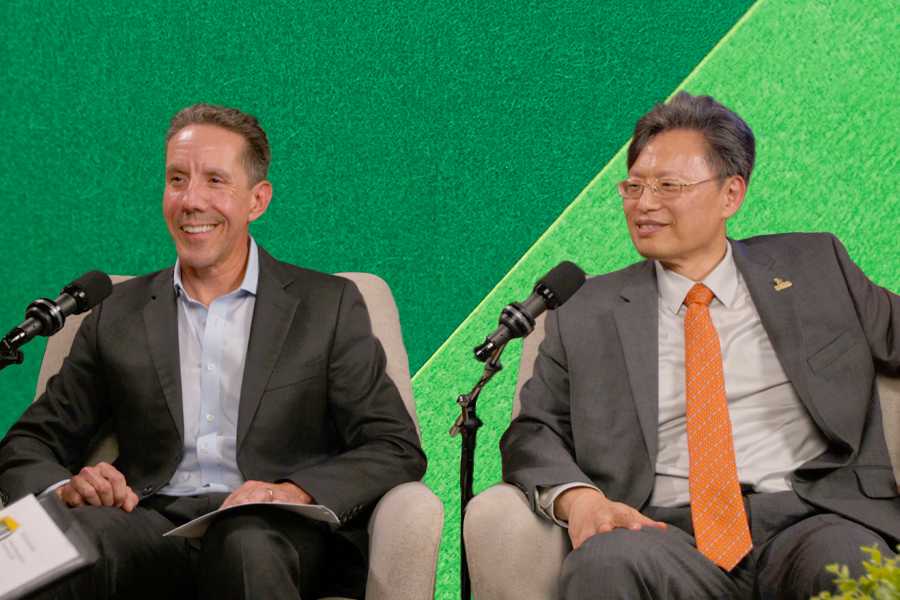
This year marks a major milestone for Baylor Engineering and Computer Science as the school celebrates its 30th anniversary. Daniel Pack, dean of Engineering and Computer Science, and Ryan Malone, a Baylor graduate and vice chair of the ECS Board of Advocates, reflect on how far the school has come—and where it’s headed next. From rapid growth in students, faculty, research and degree programs to a continued commitment to faith, purpose, and student formation, the conversation highlights how Baylor's influence in engineering and computer science continues to grow, and why it matters to pursue a call to serve at a Christian R1 university.
Show Notes
This year marks a major milestone for Baylor Engineering and Computer Science as the school celebrates its 30th anniversary. Daniel Pack, dean of Engineering and Computer Science, and Ryan Malone, a Baylor graduate and vice chair of the ECS Board of Advocates, reflect on how far the school has come—and where it’s headed next. From rapid growth in students, faculty, research and degree programs to a continued commitment to faith, purpose, and student formation, the conversation highlights how Baylor's influence in engineering and computer science continues to grow, and why it matters to pursue a call to serve at a Christian R1 university.
The conversation highlights:
- reflections on 30 years of growth, from a small program to a nationally engaged engineering and computer science school
- how ECS combines academic excellence with Baylor’s Christian mission
- what has stayed the same even as enrollment, faculty, and degree programs have expanded
- the role of world-class faculty and nationally recognized research
- how internships, undergraduate research, and competitions shape the student experience
- the importance of small classes and close faculty-student relationships
- Ryan Malone’s perspective as an alumnus and Board of Advocates leader
- how ECS aligns with Baylor’s strategic plan, Baylor in Deeds
- new and emerging academic and research areas preparing students for the future
- why the school’s next chapter is about impact, purpose, and service in the world
Transcript
Derek Smith:
Hello and welcome to Baylor Connections. I'm Derek Smith, and today we are talking Baylor engineering and computer science. This year, Baylor ECS celebrates its 30th anniversary. And as exciting as it is to look back on the ascendant history of the school, it's even more exciting to look at what's ahead as the school looks forward to tremendous growth in a number of ways that advance the Baylor mission. Our guest today to talk about that are Daniel Pack, Dr. Pack is Dean of Baylor ECS, and Ryan Malone. Ryan Malone is a 2002 Baylor graduate. He's chief development officer of Archaea Energy, and he is vice chair of the Baylor Board of Advocates. Well, Dr. Pack, Ryan, appreciate you being with us, an exciting time for the school, and we're excited to talk about that with you.
Daniel Pack:
Oh, thank you. Glad to be here.
Ryan Malone:
Great to be here. Thank you.
Derek Smith:
Great to have you both here. And Dr. Pack, let's just start broadly here. If you were talking to colleagues from another institution, as I'm sure you do, and you have the opportunity to brag about Baylor ECS, talk about things you're excited about, what are a couple of those things you might share?
Daniel Pack:
First thing is our academic program that is student-centered, an industry-recognized program, where we believe that we can combine both academic excellence with faith not being separated. And this is being recognized by our industry as 93% of placement rate attests. The second thing that I will tell them is our faculty members, how they are world-class faculty members who is standing in front of our students every day to help them to learn. And these are faculty members, more than 15% of them, who is ranked as top 2% worldwide as their work is most cited.
Third thing that I'll tell them about is student experience. Our students go through, besides the classroom activities, that they get to do internship, undergraduate research, and student organization and competition team experience, in addition to the residential college that we have where they can spend time with others, as well as the long tradition that Baylor provides in a variety of events, whether it is a Dia del oso that we just celebrated, or music and theater events, or powerful athletic events. And then finally, the last one that I will say is the community that we have, community where they're known, they're supported, and they're challenged by a faculty, staff, and friends, and colleagues.
Derek Smith:
Well, that community that you talk about, our students, our faculty, they make us proud in a lot of ways. And you just run through the back of the baseball card, if you will, has some really good stats on it for Baylor ECS and really has done so in a short amount of time. 30 years celebrates this year. We're going to talk more about the future, but what stands out to you, Dr. Pack, about the way ECS has grown in those three decades?
Daniel Pack:
I think it has been transformational in that in 1995, when we first started, that we had a little over 300 students pursuing three degrees, and with only 20 faculty members, little over 20 faculty members, who have started the school. Today, we have over 1,100 students pursuing 19 different degrees, both undergraduate and graduate degrees, with over 70 faculty members and 30 staff members working all together. But I think it's more than just the size and the scale that we have done. It's the scope of work that we do in engaging nationally significant research, and also doing so with purpose and serving others for betterment of the world.
Derek Smith:
When you think about how much it's grown in just 30 short years, it's exciting to think about what's ahead. And Ryan, you've got a unique vantage point, Baylor class of 2002, now serve on the board of advocates, so you've got to see that growth in a lot of different ways. What stands out to you from that vantage point about where ECS is now and how it's grown?
Ryan Malone:
It's a great question. And if I'm reflective on it, two things stand out, and I don't think they're opposed in any way. One is how much things have stayed the same, and second is how differently things have evolved for the school. And what I mean by that is I think the central mission of the school, obviously for Baylor, but particularly what ECS is to the school and what ECS gives to the students, has remained the same. It's about the individual, it's about their spiritual growth, it's about their social growth, and it's about their academic growth preparing them for the world. Small class sizes, intimate relationships with the professors and each other in a setting that feels like you're growing your entire person, that hasn't changed. And that's been really unique, and I think it's been one thing that the school can hold onto within ECS.
While on the other hand, I can say I'm amazed by the tremendous growth. The programs that we've added, the amount of students that we've graduated, the research that the university has brought and the school has brought, and then the real strategic focus. I haven't quite seen in the past the linkage between the importance of the school of ECS with Baylor's broader mission and vision, and I can see that clearly now. And I think the dean's done a great job in articulating the strategy of the school of ECS and making sure it's consistent with the university from that perspective. So it's been great to reflect over the past 25 to 30 years since I've graduated and to see the schools stay the same, but change dramatically.
Derek Smith:
When you talk about that, I think of that phrase we talk about a lot at Baylor since our early days when they talked about building a university susceptible of growth and enlargement to meet the needs of all the ages to come. It's a shorter timeframe that ECS has been developed in and grown in, but it's that same idea, isn't it?
Ryan Malone:
Great point. Great point. Yep. Same feeling about almost rising to the occasion just because of the way Baylor places its strategic mission and vision and where they want to grow, happen to be the areas that ECS provides. So yes, it's rising to beat the challenge from what the university expects from the school of ECS while staying consistent with what ECS is committed to doing as a student experience.
Derek Smith:
Ryan, what does it mean to you to get to serve on the board of advocates right now?
Ryan Malone:
Yeah, for me, it's an honor. I was able to talk last night as a keynote when we were recognizing students, faculty, and those who had been really successful in the research that they brought to that. And one of the core elements that I reflected on is just how much I've taken from the university over the years. And by that, they've given me a great degree. They've given me a great development as a person, not just while I was here, but in the years after and following. I met my wife the first week, and she's a Baylor graduate. And we've come to a stage in our lives in which we just want to give back to the university, realizing the further you come from Baylor and the further you move on from Baylor, the more you realize how much it shaped you. And there's a desire by myself for sure to want to give back to the university.
So for me, it's with humility and gratitude that I look back and want to be involved in what Baylor's doing more and to give of my whole self to the extent that the dean values it and whatever advice or aspects of leadership that I could bring to that and just support doing what the school needs.
Derek Smith:
Well, I know you serve with a great group on the board of advocates. We're not going to see all of them on this program, but a great team with which you get to work and help shape and guide ECS in this time of growth. And Dr. Pack, Baylor in Deeds, our strategic plan. ECS plays such an important role in you talk about that idea of in deeds, research and scholarship in action. ECS plays a big part of that. What does it mean to you to get to see ECS featured so prominently? And what does that mean for where ECS is headed?
Daniel Pack:
Well, it's a tremendous honor, but I also see that this is a time for ECS to shine as a part of Baylor University. Baylor University is a Christian R1 university, and as such, engineering, which matters quite a bit in the future, must be able to lead in engineering and computer science as a representative of Baylor. And it is important that we succeed in doing that.
Derek Smith:
Let's talk about that growth that's taking place, a picture of ECS at the moment. How would you describe some of the ways that the scope, the impact, and certainly the population, the community of ECS has grown in recent years and is now?
Daniel Pack:
Sure. So we are growing in the areas that matter for the future. So we are creating academic programs, such as aerospace engineering program, which is important for the future, biomedical engineering program. Also, very important, we are increasing our footprint in material science and engineering and AI. And those are the academic programs. We are also expanding our expertise in research, in materials, energy, human health, wireless systems, AI and data science, and then advanced computing. So these are all very important areas that we think that we will make real difference in this world, and that's where we are growing.
Derek Smith:
When you describe some of those academic areas, those aren't areas that just stay neatly within the box of the Rogers building, are they? Those are areas that allow for a lot of really interdisciplinary research and scholarship opportunities and are going to touch just about everyone at some point.
Daniel Pack:
That's correct. So the future is such that no longer a siloed approach will work. So it's intentional that we have chosen these fields that will drive that interdisciplinary work together. And those areas that I mentioned, the people who we are hiring as a faculty and attracting as graduate students will work together as a team to find solutions for challenges that we face as a nation.
Derek Smith:
Well, I know it's not just about grants and numbers, but those are pretty exciting. And we see in ECS, whether it's NSF Career Awards, major Department of Energy grants, Department of Defense, there's just a lot of different agencies that are calling on the expertise of our faculty. I think it's exciting to see that now and exciting to think about how thou that's going to grow as even more is invested into what they're doing.
Daniel Pack:
That's right. So those initial accomplishments and success that we have had in working with these different agencies are recognition that we are getting and our expertise, which will only grow. And it's also a testament of what we do are relevant and it's important for this nation and for the world.
Derek Smith:
You think about this time that you're describing, that idea of stewardship, what does it mean to each of you? And Dr. Pack, I'll start with you, to have an opportunity to steward this time in the history of ECS and direct it where it's going.
Daniel Pack:
Yeah, sure. So to me, this is very important time and critical time for ECS, but also Baylor. So the way how we are storing this is by aligning our goals, the ECS goals, with the commitment and imperatives of Baylor in Deeds, the university's strategic plan. So in that effort, we have set out our goals to improve our academic excellence and student success, grow our research, grow our engagement with communities, and elevating our recognition of our brand name and who we are in ranking systems. So those are the goals that we will use to support Baylor in Deeds.
Derek Smith:
How about you, Ryan?
Ryan Malone:
Yeah. The perspective that I would bring to it is just, you mentioned the word steward. And to me, there's a certain level of humility that comes with stewardship, and I think humility requires wisdom. And what I mean by that is I think we've got a great strategy for how ECS ties to Baylor's broader goals, and therefore what ECS needs to do. But if you look at the dynamics globally and certainly within this country, they're changing so rapidly. And I think change is the new norm, and I think the view of what an academic institution is in a changing world is going to evolve. So there's a certain amount of wisdom that I think all the colleagues on the Board of Advocates and certainly on the dean's staff bring to the equation. And what I mean by that is, are we being good stewards within that plan while allowing enough flexibility to use that humility and that wisdom to be able to guide?
And a good example of that is we talked a lot today about AI and the impact that artificial intelligence is going to have on industry for sure and what level of impact it's going to have, therefore, on the academic offering that an institution brings to it. And there was a lot of expertise in the room, and there was a lot of wisdom about being very thoughtful about what changes and what might not change for that. So I think just in a changing dynamic that we're seeing in Baylor's prominence in the state of Texas, in the United States, in the world, and the impact that they want to have, just making sure that we do bring that deep, thoughtful wisdom to some of these impacts that the university and certainly the school of ECS is going to have to think about and navigate.
Derek Smith:
Ryan, you referenced talking to colleagues and contemporaries here at Baylor ECS. I got to let people know you both are joining us after a exciting day of board meetings and discussing the future and the present with a lot of your colleagues and board members and envisioning where that is. So thank you for being willing to jump on here at the end of that long day, for sure.
Ryan Malone:
Absolutely.
Derek Smith:
Yeah, we appreciate it. As Ryan talked there, Dr. Pack, I was thinking about, he's right, things are changing rapidly. Everything's so much around technology, and the way people use it are dynamic, and they keep those of us who don't have engineering backgrounds on our toes in a lot of ways. I'm curious, as you think about your students, that student experience, really a question for both of you, Dean Pack, as a person here educating them and Ryan as someone who might hire them someday, when you think about stewarding your students' time on campus, what are some of the elements that you hope really stand out as they go apply for job when you think about they're the ones who are going to really advance Baylor ECS's impact long after their time on campus is through?
Daniel Pack:
I think the important thing that we are reminded every day is that how we educate our students and how we ensure that their experiences are really transformative experience is important. So the goal for us is every day we ask, "How do we integrate the academic excellence and then the whole person growth? How do we ensure that they not only have the competence in their discipline, but also the character that is needed for the future?" So in that aspect, we are helping our students to grow in both spiritual side as well as academic side, so they will be ready for the future.
Derek Smith:
Anything to add to that, Ryan?
Ryan Malone:
Just an emphasis of what I mentioned before. I talked to your earlier question about amazed at the growth and amazed at the change with Baylor, while also being really grateful that not much has changed relative to what Dean Pack just said in developing the whole person. So I think the entire Board of Advocates have a favorite part of the meeting and the agenda that we go through. And it's a really long day, but the most energy I take, and I think the most energy anybody takes from that meeting is when you see the students, and today we had three students that came up and talked about their experience at Baylor and what they got from it. And of course there's academic accolades, and all three of them are smarter than I ever was or could ever hope to be because I probably wouldn't have gotten into the school and they did, but they develop as an entire person.
So not only are they getting the academic advancement that makes them marketable outside of that, but you asked the question, who do I hire? I hire a person, and I hire the whole person, not just their GPA or what degree in particular, but somebody that I can trust, somebody that's fully developed as a human being that I can put in a setting that can interact with other human beings and feel compassion for them, that can drive them, that can bring the best out of them. And I think that's what we saw today. So just seeing that as an example is super powerful.
Derek Smith:
Very exciting. Very exciting. Well, as we head into the final few minutes of the program here, I want to ask you, Dean Pack, probably waited too long even to ask you this question, but Baylor's Christian mission, obviously we have a lot of faculty members. We have faculty members and students who live out their faith as they teach and as they conduct research. But what difference does that really make at ECS? What does the fact that Baylor is a Christian institution, what impact does that have on ECS?
Daniel Pack:
It has a huge impact. The fact that we are Christian R1 university attracts these talented people to Baylor at ECS. And they don't just come here for their own success, but they come here for the mission of Baylor and who we stand for. So in that aspect, what they do is more impactful and has a purpose, and they work with the service of calling for their position in impacting and transforming our students.
Derek Smith:
Yeah. There's a ripple effect as they're excellent in their field, isn't there? It unleashes their creativity on serving others and new ways that people can serve others and that's exciting to see.
Daniel Pack:
That's exactly right.
Derek Smith:
Well, final question for each of you. 30 years in, and certainly many more than 30 years to go, but I'd like to ask each of you, as you envision the next 30 years of ECS, what are you most excited about? What has you most looking forward to seeing the future take place? And Ryan, I'll start with you, and then we'll finish with Dr. Pack.
Ryan Malone:
Sure. Yeah. The next 30 years, as soon as I predict something, you can guarantee it'll be wrong. So that's the exciting thing about thinking into the future because you get to think about multiple ways that something can evolve. And an academic institution like Baylor that's been around for a hundred-plus years will obviously look very different in 30 years. But I think what I'm most excited about is watching Baylor grow and go into a changing world with distinction. And I think what I really mean by that is not that I worry about it, but I think we'd all probably acknowledge that the world's just becoming very transactional. I give you something and I get in return, and therefore it leads me to a next step, and then I get that step and I achieve that, and then I give somebody else something and I get something else in return. And that's just the way the world works.
But academics and time that people spend in an academic institution, I feel, used to be quarantined off from that process. You could go, and you could develop your whole person. You could grow spiritually and academically, and then you emerged a different person. And it wasn't always just transactional, I give you some dollars and I get a degree and I get a job. But I do think academic institutions are becoming more like that. And I don't think that's what Baylor is, and I don't think that's what Baylor's going to become.
One of my favorite quotes is from Wayne Gretzky, something to the effect of, "How'd you get so great?" And he said, "I never skated where the puck was. I skated where the puck was going." And right now, if you look at all the academic institutions, they're following a trend line, and it's very stat-driven around that. But I think Baylor's got everything that it needs to be distinctive in developing the whole person, staying true to its mission while also just achieving academic excellence in research. So I've no doubt we're going to achieve that, and it's going to be fun to watch it over 30 years.
Daniel Pack:
I'm very excited about the impact that our students and our research will make in this world. So for our students, that as we talked about, we'll be producing students with both competence and character that who will change the world with the Christian worldview and Christian based on Christian principles that they will be working. So I'm very excited about that portion. I'm also excited about the work that we are doing in the growing research areas that I've mentioned, and that we will make some fundamental changes and contributions nationwide and worldwide level that is significant and that will benefit our society. I'm excited about those two, educational portion and research portion of the impact that we'll make.
Derek Smith:
Look, that's a compelling vision that both of you share. It's exciting to see. And Dr. Pack, you mentioned all these new programs. I think you're building up that compound interest, aren't you, of the impact of our students and our faculty as these programs grow and as we add to them, and it's exciting to see. And I want to congratulate you both on getting that opportunity to be a part of this 30th anniversary and this exciting time for ECS, and I really appreciate you sharing with us. Ryan and Dr. Pack, thank you so much.
Daniel Pack:
Thank you.
Ryan Malone:
Absolutely. Thank you.
Derek Smith:
Great to have you both here on this 30th anniversary year of the Baylor School of Engineering and Computer Science. Ryan Malone and Dean Daniel Pack, our guests today on Baylor Connections. I'm Derek Smith. A reminder, you can hear this in other programs online, baylor.edu/connections, and you can find the programs on the Baylor University YouTube channel and iTunes. Thanks for joining us here on Baylor Connections.