

Kim Smith and Will Bergin
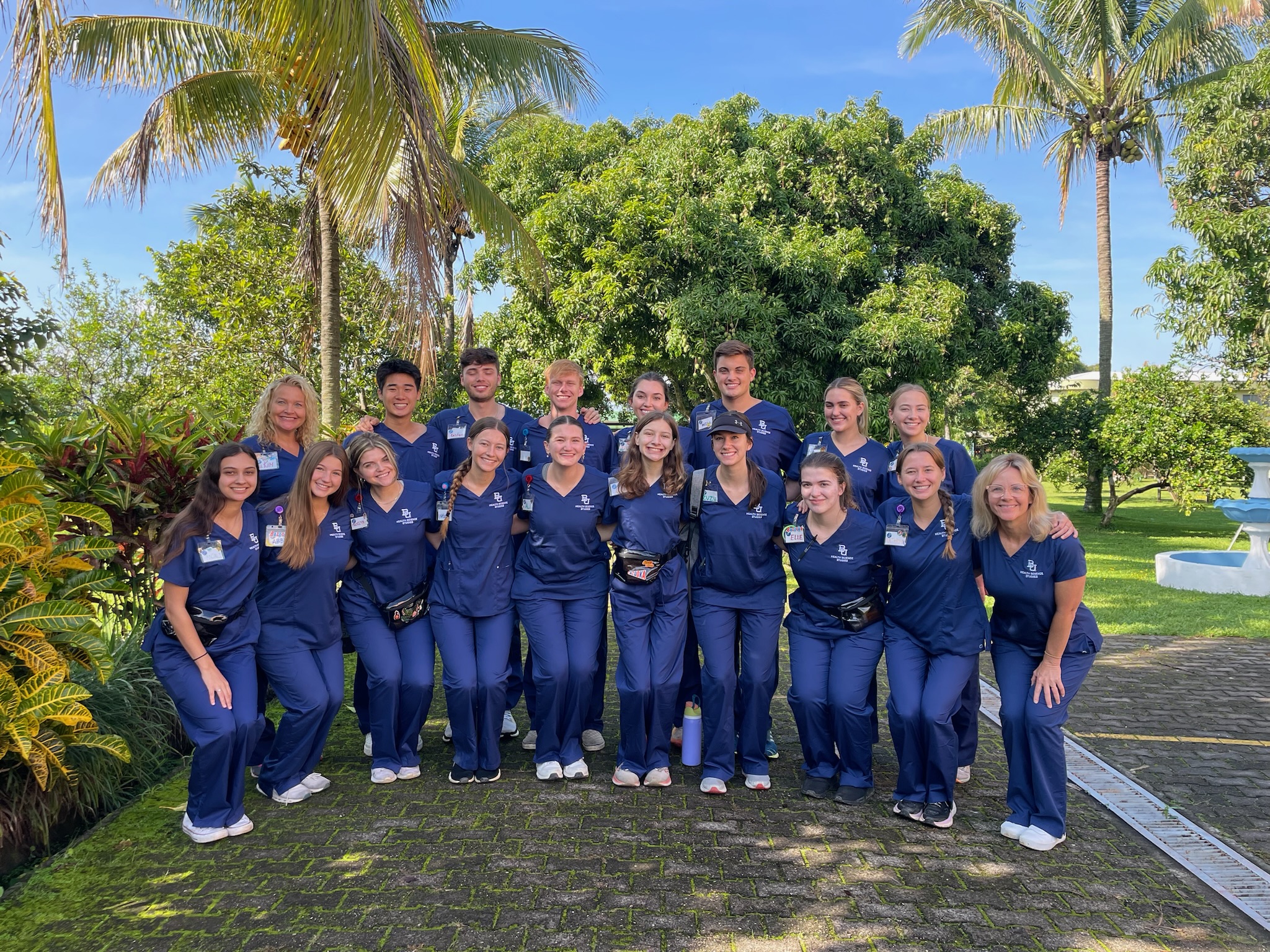
Students who participate in Study Abroad opportunities find that the experiences shape them long after the trip is through. In this Baylor Connections, a student and professor immerse listeners in their trip to Costa Rica. Kim Smith, clinical assistant professor in Health, Human Performance and Recreation, led the Health Sciences Abroad trip; Will Bergin, a senior Health & Sciences Studies major, participated. They provide insights from a life-changing summer trip.
Transcript
Derek Smith:
Hello and welcome to Baylor Connections, a conversation series with the people shaping our future. Each week, we go in depth with Baylor leaders, professors, and more discussing important topics in higher education, research, and student life. I'm Derek Smith, and today we're talking global learning opportunities for Baylor students.
Each year, Baylor University offers study abroad opportunities across the globe through the Center for Global Engagement. In every discipline, students have the opportunity to explore the world and grow professionally and personally through immersion in different cultures.
On this episode, we're going to hear from a Baylor student and professor who participated in such an experience this past summer. They were part of the Health Sciences Abroad Program. It's an annual opportunity for students to travel to Costa Rica or Belize, where they serve in pop-up clinics in vulnerable communities in partnership with local government agencies, nonprofits.
Today we're joined by Dr. Kim Smith and Will Bergin. Dr. Smith serves as Clinical Assistant Professor in Health, Human Performance, and Recreation, and she leads the annual trip. Will Bergin is a senior Health and Science Studies major from San Antonio, who participated in the trip in Costa Rica last summer.
Well, Dr. Smith, Will, it's great to have you both here with us. Excited to have your shared perspective about such a great experience for students to be a part of. Thanks so much to each of you for joining us today.
Kim Smith:
We feel blessed to join.
Will Bergin:
We do, yeah. Thank you for having us.
Derek Smith:
Well, great to have you both to share. Let's just immediately try to transport all of us to Costa Rica, last summer's trip. Dr. Smith, I'll start with you and then Will. When you think back to last summer's trip, what are some of the words and images that immediately come to mind for you?
Kim Smith:
Well, the first word I would think of would be determination. As we travel abroad, our students are experiencing something brand new for the first time, where we are able to serve patients in a vulnerable community. They have to triage the patients. So they have to learn vitals. That's the images that I see is a pop-up clinic in a community where they really need our help and our students learning and practicing vitals, and sometimes for the first time.
Will Bergin:
Yeah, I would say the two words that come to my mind are immersive, unique. This was an experience unlike anything I've done before. I didn't even really know what I was getting myself into when I showed up for the first time, but it was a really incredible experience. This was unlike anything that we could get, even in the United States. It's just a very different experience practicing with people, and then also just having that barrier between going through and learning different clinical experiences, but also having that language barrier too, getting to learn Spanish and learning really how to talk with patients.
Derek Smith:
Another question for each of you, and Will, I'll start with you. You come back to campus, life returns to normal, but how often do you find yourself thinking about that trip, whether you're in class or otherwise?
Will Bergin:
I think of this trip really often. I just have such great and fond memories from the whole trip, but it's also been really cool, especially with the classes I'm taking this semester, to be able to apply some of the different things we learned on this trip to what we're learning in class. It makes it a lot easier to learn information. You have something to reference them back to. In a lot of the pop-up clinics that we set up, we are able to go through and see different patients, a wide range of diagnoses, and really kind of get that hands-on experience that you wouldn't be able to learn just from a textbook.
Also, I just think about the trip a lot. I see a lot of people that I went on the trip often. Quite a few of them are in my classes this semester. It's really cool just how close we were able to get in only a matter of just a little over a week.
Kim Smith:
I concur. I think about it probably at least once a week, whether we're talking about tropical medicine in class or we are talking about what a standard blood pressure reading should be. I also see the students in our building as well as across campus, and it's just like we're just completely immersed back into that world where we were a team who worked together, and we could probably finish some of each other's sentences by the time we were finished with just a short-term study abroad. So I can't even imagine what a semester abroad might look like for some students.
Derek Smith:
Well, Dr. Smith, you've been a part of this trip for a while. You serve students in HHPR. First off, how long have you been leading this trip?
Kim Smith:
We started this program back in 2018, and then we were not able to take our first group in 2020 because of COVID, and I think that we finally started back up in 2022. I've gone usually with Dr. Tricia Blalock. She's our Program Director for Health Science Studies. I've led two trips, coming up on my third, and then I will lead another one this coming summer for my fourth, but I think that I've been on seven or eight.
On this, we usually have a Baylor faculty, and then we have support staff, and then we take around 14 students. Typically, they're Health Science Study students. This counts as their clinical internship for academic credit. It allows students to gain that experience while being abroad and seeing what it's like in healthcare settings outside of America.
We work with a company called International Service Learning, and they connect us with the Minister of Health for Belize or Costa Rica. They provide the location and the transportation so that we are treating people who are in the most need according to that Central American government.
Derek Smith:
Well, and that's a good point because you have these partnerships, and HHPR certainly does and other departments as well that really... What are those partnerships like, and how do they grow over the years, and building trust and also guiding you to the places where you can be most useful?
Kim Smith:
We have worked with our International Service Learning partners this whole time, and they are a really great source of knowledge and guidance for us to be able to safely administer care, and collaborate, and even tour the country. We've been able to see volcanoes and rainforests and the beaches, and all of this was through this collaboration with the International Service Learning. We really value their partnership because they also have a huge impact on servant learning and leadership and traveling internationally.
We enjoyed going to Costa Rica enough that I think we probably did four trips there before we added in Belize because we knew we had more students that wanted to go, and we knew that there were more people who needed help. And so that blossomed into the Belize opportunity, and who knows what our next one might be.
Derek Smith:
It's great new possibilities through these partnerships as we visit with Dr. Kim Smith and Will Bergin talking about study abroad experiences today on Baylor Connections.
Will, as we talk about this experience, let us get to know you a little bit as well. I mentioned you are a senior Health and Science Studies major from San Antonio. As you envision life when your time here at Baylor as an undergrad is done, where are you hoping it takes you both short term and longer term?
Will Bergin:
Yeah, absolutely. Right now I'm kind of in between going down a path for occupational therapy, but a couple of summers ago I did an internship with a physical occupational therapist and speech pathology working with kids. A lot of different professionals came in and worked and showed different equipment and things they're working on. So also have a little bit of interest going to that medical pharmaceutical sales direction as well.
After graduation, I plan to take a little bit of a break, do a little bit of traveling. This trip definitely reminded me just how much I love traveling and how much more of the world there is to see. So I'm going to take a little bit of break, do some traveling, and then either go back to school or keep working in the medical devices' direction.
Derek Smith:
Will, as you think about where you want to go, why was this trip appealing to you just as a student, even thinking about the experiences you could gain from it?
Will Bergin:
Yeah. Well, this trip first came on my radar, I knew I wanted to do a study abroad program, to be honest, I didn't think that I'd have enough time, or I'd be able to fit it into my schedule, especially going towards the end of junior year. Going into senior year, I just kind of ruled it out initially, but then this trip came up on my radar and I couldn't turn down the opportunity to submit my application in.
It's appealing one, because we're able to get our internship in just a little over a week, whereas if you were to just do it through Baylor traditionally, it'd take you the whole summer, about three months. This was a really pretty sped up process. But also it's just such a unique experience. I knew I couldn't do anything like this back home in San Antonio, find anything close to it, but also I knew that there wouldn't be another time necessarily that I'd be able to get an opportunity like this. So I knew I had to jump on it, and I'm very, very grateful that I was able to go.
Derek Smith:
This is Baylor Connections. We are visiting with Dr. Kim Smith, Clinical Assistant Professor in Baylor's Department of Health, Human Performance, and Recreation, and Will Bergin, a senior Health and Science Studies major from San Antonio here at Baylor.
You talk about the experiences, but let's delve into what those really are, specifically. Dr. Smith I'll start with. You've been a part of this for a long time now. Tell us about what you're looking to provide students and, in turn, provide the people in either Costa Rica or Belize.
Kim Smith:
Well, we know that students want an innovative experience or a unique experience, and we thought that this was a way for them to be able to explore healthcare in another country, as well as learn and practice their own skills for triaging. We just thought that serving impoverished countries and people in need in general fit the Baylor mission and vision of extending the Baylor nation and serving global population. So whenever we collaborated and determined that we could do a short-term study abroad that would achieve that, and then we saw that students were interested in it, we were just thrilled.
Derek Smith:
You talk about that you provide a pop-up clinic for people. You don't know what kind of needs people are going to come in with. Could each of you... Dr. Smith, I'll start with you... just tell us about some of the things you see that are both maybe the every day and the not so every day?
Kim Smith:
Well, sure. In class, we talk about all sorts of situations that people live in. Whenever you're a physician or a PT or an OT or a dentist and somebody comes to your clinic, you don't really know their background and who they're living with and any of that. On this trip, we do home visits prior to treating the patients so that we see are they cooking with wood indoors, do they have a latrine outside or are they using a restroom that has flushable plumbing on the inside? So it allows students to see where their patients are coming from prior to treating them, and soften their heart towards whatever the person is presenting with. We feel like that is really valuable.
In addition to that, students are able to spend about an hour in a team triaging a patient, where in America, most physicians spend about 15 minutes and PT might spend 55 minutes with the patient. This just allows them to have a little extra time to practice their conversational Spanish, as well as just having a conversation with the future patient or a current patient.
Will Bergin:
Yeah, I would add on to that a little bit more about just spending time with patients. This is a really pretty special experience because we were able to spend just so much time with people, whereas before in any other setting, we wouldn't necessarily be able to.
We had three different groups that we were split up into. There was a physical therapy group, a pre-medical group, and then a couple of other groups just doing some more assessments. With that, we were able to go through and talk with the patients and figure out what are the biggest problems that need to be addressed, what are some different solutions that we could fix right there in the clinic? In some cases, if they needed medication, if they needed some guidance, we could send them over to other teams to be seen. But most importantly, we were just there to listen to them, to hear everything that they wanted to express to us, and then also give them some different options about how to treat certain things at home once we're gone, giving them certain stretches or tools to be able to continue those treatments after their experience with us.
Yeah, being able to go through and actually see where people are living, it gave us a really great perspective as to be really observant when working with patients and also just be as good of a listener as we possibly can be. Those are two big things that are sometimes kind of left out in normal healthcare setting, and so that was just a really good reminder for all of us as we're going to healthcare fields, just remember those.
Derek Smith:
Will, you talk about having conversations, listening. What's it like working through the language barrier? How did you prepare, and what would that look like?
Will Bergin:
Yeah. Every group that we went to, both when we were in the pop-up clinics, but also we were doing home visits, we had a translator with us. That definitely helped a lot if we needed to help explain some things. We could just talk to the translator, and they'd translate it back to the patients. This was also a great opportunity for us to learn a little bit of Spanish. We were all taught pretty simple phrases to repeat and understand when we were visiting with patients. We first went up to their doors and introduced ourselves, explained that we were students visiting from the United States offering a free healthcare pop-up clinic just right down the road. I think that really made a big difference.
It was definitely a little bit uncomfortable for a lot of us when we first started. We were a little worried about talking and trying to figure out the right thing to say and what to do, but the translators made the process really easy, and we also learned a little bit more in the process as well.
Derek Smith:
Dr. Smith, as they meet people in the communities, could you paint a broader picture for us of who are the people that you're meeting? Obviously, you have these connections that lead you to them. Who are they?
Kim Smith:
International Service Learning connects us with the villages or these vulnerable communities.
In the first community, La Carpio, that we were this summer, just imagine duplexes next to each other, actually row homes, but it just being a one-room building for the whole family of four or five to live. The mom stays home during the day. She is a housewife. Her responsibilities include feeding anyone that's home all of the meals, packaging up the laundry, and walking down to the sink, and washing the laundry by hand and then hanging it out to dry. This is daily. The dad would go to work every day and then come home. And then the kiddos, they go to school in uniforms.
The second community, which is called Los Huevitos, they named themselves Little Egg because each of the building, it's tin metal, they just attach one room to the next, and so there's literally a whole community that is just made of corrugated metal, and the same thing happens there. The floors there are made of dirt, and there are a few stray dogs running around.
These people are in-community with one another, and we like to provide them just with as much healthcare as we can while we're there.
International Service Learning has a pharmacist with us, and so whatever the physician in-country or the physical therapist in-country diagnosis the patient with, we're usually able to give out pharmaceuticals for free through International Service Learning and the in-country pharmacist, and so our students get to see what that's like too. Because International Service Learning has a relationship with these communities, it's not just Baylor going to these locations; it's other universities and other high schools and some graduate programs, and so they're used to seeing the Americans come, and they come running.
Derek Smith:
Just visiting with Dr. Kim Smith and Will Bergin. As we head into the final few minutes of the program, Will, I want to ask you; are there any experiences or people that just particularly linger in your mind from your experience this summer?
Will Bergin:
Yeah, there are a lot of people that we were able to treat that we got pretty close with, especially people that might've been with us one day, and then we told them to come back the next day. We really got a lot of time with them, and time to be able to hear more about their story and what kind of things they needed assistance with.
One of the moments that really kind of sticks out to me is we had one afternoon where we closed down the clinic, cleared everything out, and invited a whole bunch of kids from the community to come play with us. The whole goal behind this was that sometimes doctors can be perceived as scary or intimidating to kids. We really just want to be as open, welcoming, and inviting to them as we possibly can. We brought out a whole bunch of games, balls, activities. I think some of the younger kids did nail painting and coloring books, and everything else. We really just got to play with kids for pretty much the whole afternoon.
Just thinking about that, that's also a really pretty unique experience on its own. Just being able to teach to communities that we're here to help in any way we can, but more importantly, this is a collaborative experience between all of us. We're here right alongside you. Whatever you need, we're going to help you through every step of the way.
Derek Smith:
Well, great memories that you share there Will, and obviously great experiences.
Dr. Smith to close this out, obviously you get to serve from the faculty perspective working with these students, you and some of your colleagues, as you look ahead to more opportunities, what most excites you for students attending these trips, whether they're in HHPR or whatever their discipline is?
Kim Smith:
Sure. Global experiences, I believe, help to round out a student, to help them be more competitive for a job or for application to professional school, and even helps them be a better teammate on an interprofessional level. I think that this experience, and I think that what we get to offer our students is that they become more competitive, that they're going to be a stronger future practitioner, that they have more belief in their self abilities to treat patients and to have conversations and to work as a team and to understand culture, and to really be humbled by it. And just to show them exposure to the greater US, and the greater international global healthcare scene so that they can make a determination if that's something that they see in their future as well.
I'm just excited about the opportunity to continue Pro Mundo and to spread Baylor Nation globally.
Derek Smith:
Absolutely. Yep, Pro Mundo, it's part of the motto now, and this is a great picture of what that will look like.
Well, Will, Dr. Smith, thank you both so much for coming on the program. I'm glad that you both got to share in this, and I hope this conversation maybe encourages other students down the line to do so as well. Appreciate both of your time very much.
Dr. Kim Smith, Clinical Assistant Professor in Health, Human Performance, and Recreation, and Will Bergin, senior Health and Science Studies major, our guests today on Baylor Connections. I'm Derek Smith.
A reminder: You can hear this and other programs online at baylor.edu/connections, and you can subscribe on iTunes.
Thanks for joining us here on Baylor Connections.